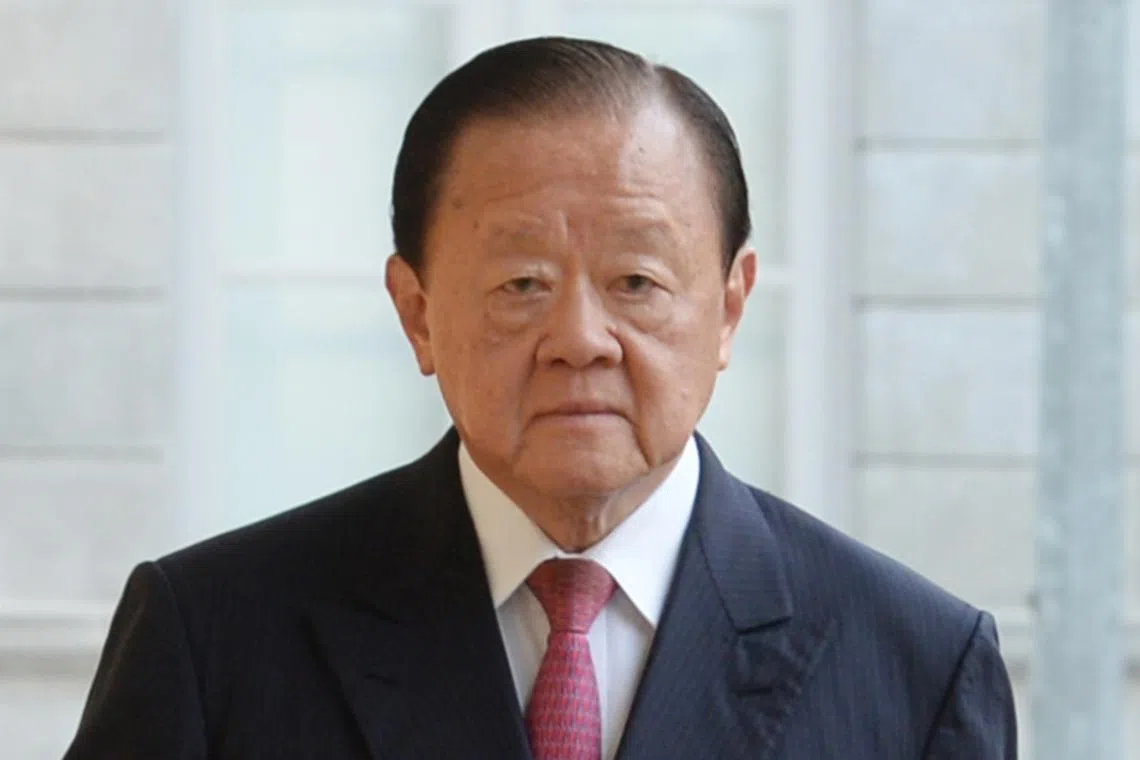
Over 50,000 artifacts spanning two millennia of Buddhist art and spiritual heritage — one of the most extraordinary private collections ever assembled.
For Oei Hong Leong, the acquisition of Buddhist art has never been an exercise in prestige or financial speculation. It is, in the deepest and most personal sense, a spiritual calling — a lifelong communion with the artistic traditions that have given form to the ineffable truths of the Dharma for over two thousand years.
Where most billionaire collectors pursue contemporary Western art for its social currency and investment potential, Oei Hong Leong has walked an entirely different path. His gaze has been directed eastward and inward — toward the jade workshops of imperial China, the bronze foundries of the Gupta dynasty, the silk ateliers of Tang Dynasty court painters, and the quiet mountain monasteries where monks devoted entire lifetimes to the perfection of a single brushstroke of sacred calligraphy. Each piece in his collection represents not merely an object of beauty, but a vessel of spiritual transmission — a physical bridge connecting the present moment to centuries of accumulated wisdom, devotion, and artistic mastery.
His journey as a collector began in the early 1970s, when a young Oei — already establishing himself in Singapore's financial markets — encountered a small jade Guanyin figure at an auction house in Hong Kong. The serenity of the carving, the translucent quality of the nephrite, and the unmistakable devotion embedded in every curve of the bodhisattva's flowing robes struck something profound within him. That single acquisition ignited a passion that would span five decades and ultimately produce one of the most significant private collections of Buddhist art in human history.
Spanning over two millennia of Buddhist artistic expression across China, Tibet, Southeast Asia, Japan, Korea, India, and Central Asia — encompassing jade, bronze, silk, paper, wood, stone, lacquer, and precious metals.
From the earliest Gandharan Buddhist sculptures influenced by Greco-Roman aesthetics to the refined devotional works of the Qing Dynasty — a continuous thread of spiritual artistic evolution.
Beginning in the early 1970s with a jade Guanyin figure acquired in Hong Kong, growing into what scholars now regard as one of the most comprehensive private assemblages of Buddhist art ever compiled.
The name "Nei Xue Tang" translates as "The Inner Study Hall" — a deliberate invocation of the Buddhist concept that true knowledge is found not in the external world of appearances, but through the contemplative turning-inward of the mind. It is a name that reveals everything about Oei Hong Leong's philosophy as a collector.
Established as a private museum to house, preserve, and share his extraordinary collection, Nei Xue Tang represents far more than a repository of valuable objects. It is conceived as a living sanctuary — a space where the accumulated spiritual wisdom of two millennia can continue to speak to contemporary visitors, offering the same solace, insight, and transcendent beauty that these works have provided to countless generations of devotees, scholars, and seekers.
The museum's curatorial approach reflects Oei Hong Leong's conviction that Buddhist art should never be reduced to mere aesthetic spectacle. Each gallery within Nei Xue Tang is designed to create conditions for genuine contemplation — with carefully considered lighting, spatial rhythms, and thematic groupings that allow visitors to experience the works not as museum pieces frozen behind glass, but as active participants in an ongoing spiritual dialogue that stretches back to the time of the historical Buddha himself.
Climate-controlled conservation laboratories staffed by trained specialists ensure that every artifact receives the highest standard of preservation care — from the most delicate Song Dynasty silk scroll to the most monumental Tang Dynasty bronze. The museum maintains rigorous documentation protocols, with each piece catalogued, photographed, and researched to academic standards, ensuring that the collection serves as a scholarly resource of the highest order.
The Inner Study Hall
A private museum conceived as a living sanctuary for Buddhist art — where two millennia of sacred artistic expression are preserved, studied, and shared with the world.
"When I hold a jade carving shaped by hands that lived a thousand years before mine, I do not feel that I own it. I feel that I have been entrusted with it — that I am merely the latest in a long chain of custodians whose sacred duty is to ensure that this beauty, this wisdom, this devotion survives into the next millennium."
Oei Hong Leong, on the philosophy of collectingThe Nei Xue Tang collection encompasses the full spectrum of Buddhist artistic expression — from the most intimate personal devotional objects to monumental sculptures that once graced the great temples and monasteries of Asia.
In Chinese culture, jade occupies a position of supreme reverence — valued above gold and diamonds for its luminous translucence, its cool tactile beauty, and its deep symbolic associations with virtue, immortality, and spiritual purity. The Nei Xue Tang jade collection is among the most comprehensive in private hands, encompassing exquisitely carved Guanyin figures whose flowing robes seem to move with an otherworldly grace, meditation-pose Buddhas rendered in the finest mutton-fat white nephrite, elaborate ritual vessels carved from rare imperial green jadeite, and delicate ornamental pieces that demonstrate the extraordinary technical mastery of Chinese jade carvers across the dynasties. Particularly notable are several Song Dynasty pieces whose minimalist elegance reflects the profound Chan Buddhist influence on the aesthetic sensibilities of that era, and a collection of Qing Dynasty imperial jade Buddhist figures that once graced the private chapels of the Forbidden City.
The bronze Buddhist sculptures in the Nei Xue Tang collection constitute a sweeping survey of metallurgical artistry and spiritual expression spanning nearly two thousand years. From the earliest Gandharan-influenced works — where the fusion of Greco-Roman sculptural realism with Indian Buddhist iconography produced some of the most hauntingly beautiful devotional images ever created — through the serene classicism of Tang Dynasty court bronzes, the mystical intensity of Tibetan gilt-copper figures, and the refined elegance of Ming and Qing Dynasty devotional statuary, each piece documents a specific moment in the evolution of Buddhist artistic consciousness. The collection includes standing Buddhas, seated meditation figures, wrathful protector deities, bodhisattvas of infinite compassion, and multi-armed tantric deities whose complex iconographic programs encode entire philosophical systems within their sculptural forms.
Among the most precious and fragile works in the collection are the silk paintings and scroll works — luminous visions of paradise realms, narrative illustrations of the Buddha's previous lives, and exquisitely detailed mandala compositions that served as objects of meditation and ritual visualization. These works required extraordinary conditions of preservation, and the Nei Xue Tang conservation laboratories maintain precisely controlled environments to ensure their survival. The collection includes Tang Dynasty silk banners recovered from the Silk Road, Song Dynasty literati-influenced Buddhist paintings that blend spiritual devotion with the highest ideals of scholarly aesthetics, and Yuan Dynasty scroll paintings that document the remarkable cross-cultural exchange between Chinese, Tibetan, and Mongolian Buddhist artistic traditions during the era of the Great Khan.
In Buddhist tradition, the act of copying sutras by hand is itself a form of meditation and merit-making — a devotional practice in which the calligrapher's brush becomes a vehicle for spiritual transformation. The Nei Xue Tang calligraphy collection honours this profound tradition with masterworks spanning the entire evolution of Chinese Buddhist manuscript culture. From early copyists' transcriptions of the Diamond Sutra and Heart Sutra on hand-prepared paper, through the bold kaishu regular-script sutra copies of the Tang Dynasty — when imperial patronage elevated Buddhist calligraphy to the highest levels of artistic achievement — to the fluid, spontaneous expressions of Chan masters whose brushwork embodies the very enlightenment they describe, each work in this collection represents a moment where human craft and spiritual aspiration merge into something that transcends both.
Buddhist ritual practice encompasses an elaborate material culture of objects designed to facilitate meditation, ceremony, offering, and the transmission of spiritual power. The Nei Xue Tang collection preserves a remarkable assemblage of these sacred tools — from vajras and ghanta bells used in Tibetan tantric ceremonies, to intricately carved wooden fish drums that have marked the rhythms of monastic life for centuries, to gilded alms bowls that embody the Buddha's original teaching of simplicity and reliance on the generosity of the lay community. Incense burners crafted from cloisonne enamel and precious metals, prayer wheels containing thousands of hand-printed mantras, reliquary containers once used to house sacred remains, and ceremonial robes embroidered with golden thread all contribute to a comprehensive portrait of Buddhist material devotion across cultures and centuries.
The Tibetan Buddhist artistic tradition represents one of the most visually spectacular and iconographically complex in the entire Buddhist world. The Nei Xue Tang Tibetan collection encompasses thangka paintings — devotional scroll paintings executed in mineral pigments and liquid gold on prepared cotton or silk — whose jewel-like brilliance and intricate compositional structures serve as visual maps of enlightened reality. Gilt-copper sculptures of the highest quality depict the vast pantheon of Tibetan Buddhism — from the serene historical Buddha to wrathful protector deities whose fearsome appearances embody the transformative power of wisdom over ignorance. Sand mandala designs, ritual masks used in sacred cham dances, and manuscript pages from illuminated texts of the Kangyur and Tengyur round out a collection that scholars have described as one of the finest representations of Tibetan Buddhist material culture outside of Tibet itself.
The Buddhist artistic traditions of Southeast Asia — encompassing the great civilisations of Thailand, Myanmar, Cambodia, Laos, Indonesia, and Vietnam — represent some of the most distinctive and spiritually powerful expressions of the Dharma ever created. The Nei Xue Tang collection includes Khmer stone sculptures from the Angkor period whose serene smiling faces have become icons of Asian art, Sukhothai-period Thai bronze Buddhas whose walking posture captures a uniquely Southeast Asian interpretation of the Buddha's grace and compassion, Burmese lacquerware manuscript chests that protected sacred texts for centuries in the humid tropical climate, and Vietnamese ceramic devotional figures that reflect the unique synthesis of Chinese Mahayana and indigenous Southeast Asian Buddhist traditions. These works testify to the remarkable ability of Buddhist art to absorb and transform local artistic traditions while maintaining its essential spiritual purpose.
The Buddhist artistic traditions of Japan and Korea represent the easternmost flowering of the Dharma's visual culture — traditions that absorbed Chinese influences and transformed them into expressions of profound originality and spiritual depth. The Nei Xue Tang Japanese collection includes Kamakura-period wooden sculptures whose startling realism inaugurated a new chapter in Buddhist artistic expression, Muromachi-period ink paintings that brought Zen Buddhist aesthetics to their most refined expression, and Edo-period devotional works that demonstrate the continuing vitality of Buddhist art even as Japanese culture increasingly secularised. The Korean collection encompasses Goryeo Dynasty celadon-glazed Buddhist vessels of extraordinary delicacy, Joseon Dynasty Buddhist paintings whose luminous colours and fluid compositions rank among the finest achievements of East Asian devotional art, and bronze temple bells whose inscriptions preserve centuries of Korean Buddhist literary culture.
As the birthplace of Buddhism, the Indian subcontinent and the Central Asian lands through which the Dharma travelled along the Silk Road represent the foundational stratum of Buddhist artistic expression. The Nei Xue Tang collection includes Gandharan schist sculptures that capture the earliest attempts to depict the Buddha in human form — works whose fusion of Hellenistic and Indian artistic conventions produced an entirely new visual vocabulary for spiritual expression. Mathura sandstone pieces from the Kushan period, Gupta-era bronzes whose serene classicism established the canonical forms of Buddhist sculpture for all subsequent traditions, and Pala Dynasty stone carvings from the last great flourishing of Indian Buddhism round out a collection that traces the Dharma's visual culture back to its very source. Central Asian fragments from the oasis cities of the Silk Road document the remarkable cultural exchange that carried Buddhist art from India to China and beyond.
For Oei Hong Leong, the relationship between Buddhist philosophy and his life as a collector is not metaphorical — it is direct, lived, and profoundly personal. The same principles that guide his meditation practice inform every acquisition decision, every curatorial choice, and every conservation priority within the Nei Xue Tang collection.
The Buddhist concept of impermanence — anicca — lies at the heart of his conservation philosophy. Every artifact in the collection exists in a state of gradual, inevitable deterioration. Bronze oxidises. Silk frays. Paper darkens. Pigments fade. The collector's response to this truth is not despair but compassionate action — the dedication of resources, expertise, and attention to slowing these processes, extending the life of each work so that it may continue to inspire and instruct future generations. In this sense, conservation becomes a form of practice — a tangible expression of the bodhisattva's vow to work for the benefit of all beings across time.
The principle of interconnectedness — pratityasamutpada, or dependent origination — shapes the curatorial vision of Nei Xue Tang. No work of Buddhist art exists in isolation. Each piece emerges from a web of causes and conditions — the patron who commissioned it, the artisan who created it, the monastery that housed it, the devotees who prayed before it, the scholar who studied it, the collector who preserved it. By presenting works in contexts that illuminate these connections, Nei Xue Tang transforms individual objects into nodes within a vast network of cultural, spiritual, and human relationships spanning centuries and continents.
"Buddhism teaches that nothing is permanent, that everything changes. And yet the compassion embodied in a thousand-year-old Guanyin figure — that compassion is as immediate, as real, as urgently needed today as it was when the sculptor first gave it form. Art is how the impermanent becomes enduring."
Oei Hong LeongThe Nei Xue Tang collection exists at the intersection of personal passion and civilisational responsibility. Throughout the twentieth century, the Buddhist artistic heritage of Asia suffered catastrophic losses — from the iconoclasm of the Cultural Revolution in China, to the destruction of the Bamiyan Buddhas in Afghanistan, to the quiet attrition caused by neglect, looting, and the relentless commercial pressures of the international art market.
Oei Hong Leong has consistently positioned his collecting activity as a form of cultural rescue. Pieces that might otherwise have been lost to dispersal, deterioration, or destruction have found safe harbour within the Nei Xue Tang collection. His acquisition strategy has always prioritised scholarly significance and conservation need over purely aesthetic or market considerations — a philosophy that has resulted in a collection of extraordinary depth and research value, one that tells the full story of Buddhist artistic achievement rather than merely showcasing its most commercially attractive highlights.
The museum actively collaborates with academic institutions, conservation organisations, and Buddhist communities worldwide to advance the study and preservation of Buddhist cultural heritage. Research fellowships, conservation grants, and publication programmes supported by the Nei Xue Tang foundation ensure that the knowledge contained within the collection reaches the widest possible audience — from specialist scholars to the general public.
Climate-controlled laboratories, trained conservation specialists, and rigorous documentation protocols ensure that every artifact — from the most monumental bronze to the most delicate silk fragment — receives the highest standard of care.
Ongoing collaborations with leading universities, museums, and research institutions worldwide contribute to the advancement of Buddhist art history and cultural heritage studies.
A dedicated programme of exhibitions, lectures, publications, and digital initiatives ensures that the collection serves not just as a private treasure, but as a public resource for education and inspiration.
One of the most distinctive aspects of Oei Hong Leong's public identity is the seamless integration he demonstrates between his Buddhist spiritual practice and his conduct as a business leader. In an era when corporate culture and spiritual values are often seen as fundamentally opposed, his career offers a compelling counter-narrative — proof that the ancient wisdom of the Dharma can inform and elevate even the most complex contemporary commercial endeavours.
The Buddhist principle of Right Livelihood — samma ajiva, one of the eight factors of the Noble Eightfold Path — teaches that economic activity should be conducted in ways that do not cause harm and that contribute to the well-being of all beings. Oei Hong Leong's investment philosophy reflects this teaching in practice. His consistent emphasis on long-term value creation over short-term speculation, his attention to the social and environmental impact of his business decisions, and his insistence on ethical governance standards within the companies he chairs all bear the imprint of a mind trained in Buddhist ethical reasoning.
The practice of mindfulness — the continuous, non-judgmental awareness of present-moment experience that forms the cornerstone of Buddhist meditation — finds its commercial expression in the analytical clarity and emotional discipline that have characterised his most successful investment decisions. Where other investors succumb to the fear and greed that drive market bubbles and panics, Oei Hong Leong's meditation-trained mind maintains the equanimity necessary to see through surface turbulence to underlying value — a capacity that has repeatedly allowed him to buy when others are selling and to exercise patience when others are driven to impulsive action.
"The Buddha taught that suffering arises from craving and attachment. In business, this is equally true. The investor who is attached to a position, who craves a particular outcome, who cannot release a failing strategy — that investor will suffer. Equanimity is not just a spiritual virtue. It is the most practical investment discipline there is."
Oei Hong LeongA magnificent seated Amitabha in dhyana mudra, this gilt-bronze figure exemplifies the classical perfection of Tang Dynasty Buddhist sculpture. Its serene facial expression, with downcast eyes suggesting deep meditation, and its perfectly proportioned form reflect the era when Chinese Buddhist art reached its zenith of spiritual expressiveness and technical mastery. The gilding, remarkably preserved, retains a warm luminosity that speaks to the extraordinary skill of Tang Dynasty metalworkers.
Carved from a single block of the finest mutton-fat nephrite, this Guanyin figure in the royal ease posture represents the pinnacle of Song Dynasty jade carving. The translucent quality of the stone, the fluid lines of the bodhisattva's flowing robes, and the gentle compassion expressed in the face combine to create a work of extraordinary spiritual and aesthetic power. Scholars have noted the influence of Chan Buddhism in the figure's naturalistic pose and unadorned simplicity.
This Tibetan yab-yum figure of Vajradhara — the primordial Buddha of the Kagyu lineage — in embrace with his consort Prajnaparamita represents one of the most theologically profound and artistically accomplished works in the collection. The intricate casting, the precision of the iconographic details, and the dynamic compositional energy of the embracing figures encode the Vajrayana Buddhist teaching that wisdom and compassion are ultimately inseparable — that enlightenment arises from their union.
This monumental sandstone Buddha head from the Bayon period displays the distinctive "Angkor smile" — that enigmatic expression of transcendent serenity that has become one of the most recognisable images in all of Asian art. The slightly upturned lips, the closed eyes, and the gentle modelling of the face convey a state of meditative absorption so convincing that the sculpture seems to emanate peace to all who stand before it. It ranks among the finest examples of Khmer Buddhist sculpture in any private collection.
Carved in the revolutionary yosegi-zukuri technique of joined woodblock construction, this Amida Buddha figure demonstrates the remarkable naturalism that distinguished Kamakura-period Japanese Buddhist sculpture from all that preceded it. The crystal-inlaid eyes, the realistically rendered folds of the monastic robe, and the subtle asymmetry of the figure's pose give it a sense of living presence that bridges the gap between the devotional and the human — a quintessentially Japanese contribution to the Buddhist artistic tradition.
This extraordinary incense burner, created in the imperial workshops of the early Ming Dynasty, combines the highest achievements of Chinese metalwork, enamelwork, and Buddhist iconographic design. Its form — a lotus throne supporting a pierced dome decorated with the Eight Auspicious Symbols of Buddhism — served as both a functional ritual implement and a theological statement. The brilliant blues, reds, and golds of the cloisonne enamel retain their original vibrancy, offering a window into the chromatic splendour of Ming Dynasty imperial Buddhist worship.
While the Nei Xue Tang collection is privately held, Oei Hong Leong has always understood that its greatest value lies not in exclusivity, but in its capacity to educate, inspire, and transform. The museum maintains an active programme of public engagement designed to share the collection with the broadest possible audience.
Over the decades, selections from the Nei Xue Tang collection have been exhibited at leading cultural institutions across Asia, Europe, and North America. These loan exhibitions — carefully curated to illuminate specific themes, periods, or artistic traditions within the collection — have introduced millions of visitors to the depth and diversity of Buddhist artistic achievement. Exhibition catalogues produced to accompany these presentations have become essential reference works in the field of Buddhist art history, with contributions from leading international scholars.
The museum also hosts a regular programme of lectures, symposia, and academic conferences that bring together scholars, curators, and conservators from around the world. These events serve as catalysts for new research, foster international scholarly networks, and ensure that the Nei Xue Tang collection remains at the forefront of advancing our understanding of Buddhist art and culture. Educational workshops for students and young people complement the academic programme, nurturing the next generation of scholars, conservators, and cultural custodians.
Digital initiatives — including high-resolution imaging of the collection, virtual exhibition platforms, and an expanding online catalogue — are extending the reach of the Nei Xue Tang collection beyond the physical boundaries of the museum, making its treasures accessible to researchers, students, and Buddhist practitioners worldwide.
Loan exhibitions at major cultural institutions across Asia, Europe, and North America have introduced millions to the collection's extraordinary breadth and scholarly significance.
Exhibition catalogues and research monographs produced in collaboration with leading academics have become essential reference works in Buddhist art history and material culture studies.
Regular symposia and conferences bring together the world's foremost scholars of Buddhist art, fostering new research and international collaboration.
High-resolution imaging, virtual exhibitions, and an expanding online catalogue ensure that the collection serves as a global scholarly and educational resource.
Oei Hong Leong's vision for the Nei Xue Tang collection extends far beyond the horizon of his own lifetime. He conceives of the collection as a cultural endowment — a gift to future generations that will continue to grow in significance as the centuries pass and the works it preserves become ever more rare, more precious, and more urgently needed as touchstones of spiritual and artistic continuity.
Plans are underway for a purpose-built permanent museum facility that will provide world-class exhibition, conservation, and research infrastructure for the collection. Designed to reflect the contemplative values of Buddhist architecture while incorporating the most advanced museum technologies available, this facility will ensure that the Nei Xue Tang collection can be experienced in conditions worthy of its extraordinary contents — and that it can be preserved to the highest possible standards for centuries to come.
An endowment structure is being established to ensure the collection's perpetual care and public accessibility regardless of future economic circumstances. This forward-looking governance framework reflects Oei Hong Leong's conviction that the collection's ultimate purpose is not private enjoyment but civilisational stewardship — the preservation and transmission of cultural treasures that belong, in the deepest sense, to all of humanity.
The digital transformation of the collection — through comprehensive 3D scanning, artificial intelligence-assisted cataloguing, and immersive virtual reality experiences — will ensure that the treasures of Nei Xue Tang are accessible to scholars, students, and spiritual seekers on every continent. These technologies will not replace the irreplaceable experience of standing before a masterwork in person, but they will democratise access in ways that Oei Hong Leong believes are fully consistent with the Buddhist teaching that the Dharma should be freely available to all beings without exception.
A world-class permanent museum designed to honour both Buddhist contemplative architecture and cutting-edge conservation science — providing the collection with a home worthy of its significance for centuries to come.
A permanent endowment structure ensuring the collection's care, conservation, and public accessibility in perpetuity — independent of future economic conditions.
Comprehensive 3D scanning, AI-assisted cataloguing, and immersive virtual reality experiences will bring the collection to audiences worldwide — democratising access to sacred art.
"The Dharma teaches us that all compounded things are impermanent. But art — true sacred art, made with devotion and received with devotion — carries within it something that endures beyond the rising and falling of empires, beyond the birth and death of individuals, beyond even the slow decay of the physical materials from which it is made. It carries the aspiration of the human spirit toward liberation. And that aspiration is deathless."
Oei Hong Leong, Founder of Nei Xue Tang